What occured during the same time as the beginning of the decline of women in computer sciene?
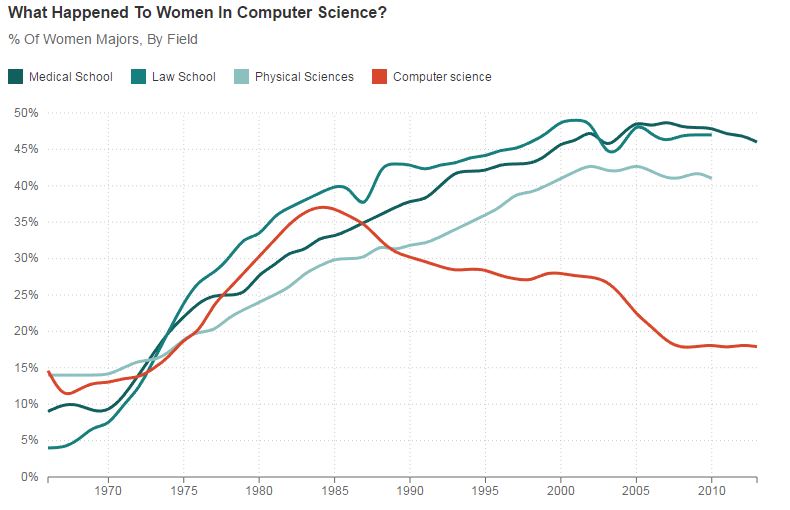 A lot of computing pioneers — the people who programmed the first digital computers — were women. And for decades, the number of women studying computer science was growing faster than the number of men. But in 1984, something changed. The percentage of women in computer science flattened, and then plunged, even as the share of women in other technical and professional fields kept rising
Why does it matter that males had been playing on computers growing up?
These early personal computers weren’t much more than toys. You could play pong or simple shooting games, maybe do some word processing. And these toys were marketed almost entirely to men and boys. This idea that computers are for boys became a narrative. It became the story we told ourselves about the computing revolution. It helped define who geeks were, and it created techie culture.
What three take-a-ways do you have looking at this data?
- by my eyes and mind to see the rating .
- by filtering up of each column in data.
- by feedbaks.
When are diversity efforts most successful?
 Diversity efforts are most successful when they’re driven by a commitment from company leaders. And meaningful commitment requires leaders to understand why diversity matters. At Paradigm, we spend a lot of time brainstorming with CEOs and other company leaders about what is or should be driving their diversity and inclusion efforts.
Why do diverse companies perform better?
Given that diverse teams are smarter and more creative than homogeneous ones, it is unsurprising that a wealth of research shows a strong correlation between diverse organizations and positive financial outcomes. In a 2011 study of diversity in the top firms in Standard & Poor’s Composite 1500 list, researchers found “female representation in top management leads to an increase of $42 million in firm value.”
Give an example of how a diverse company can serve a diverse user base or vise-versa.
For company leaders beginning to consider diversity and inclusion, understanding these rationales and identifying one that resonates for you and your organization can be a helpful first step.